BRECHT
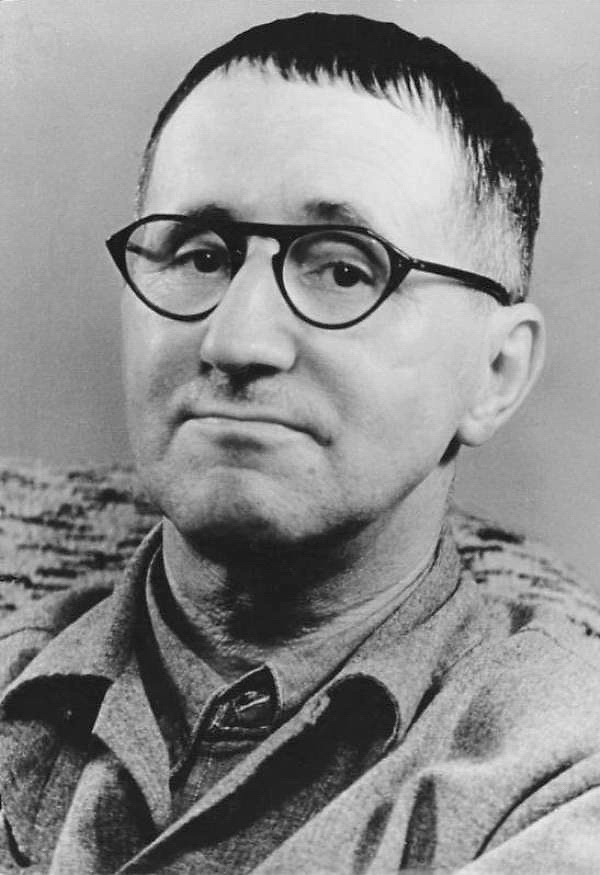
About Brecht
- Born in Augsburg Bavaria
- His mother was a Protestant and his father was a Catholic
- Brecht gained a great knowledge of the bible as a child from his mother which is evident in his later work.
- He met Casper Neher at school wth whom he would form a life-long creative partnership with.
- Brecht was 16 when WW1 broke out and nearly joined the army before seeing so many people that he knew killed or injured. Brecht and his father found a loophole to avoid Brecht being conscripted to the war
- In 1917 Brecht studied at the University of Munich where he also studied Theatre.
- In 1919 Brecht had his first child and only a year later Brechts mother passed away
- In 1920/21 Brecht was involved in the political cabaret of the comedian Karl Valentin. Brecht compared him to Charlie Chaplin and saw him perform many times.
- In 1922 Brecht caught the attention of one of Germanys most influential critics who stated that "At 24 the writer Bert(olt) Brecht has changed Germany's literary complexion overnight"
- Brecht had two daughters that became successful actresses
- Brecht spent the last years of the Weimar era working on his "collective"on Lehrstücke (a group of plays driven by morals, music and Brecht's Epic Theatre.
- By February 1933, Brecht's work was eclipsed by the rise of the nazi rule in Germany
- Fearing prosecution Brecht fled to Denmark with his family for 6 years.
- During the war Brecht became a prominent writer of the Exilliteratur. He expressed his disaproval pf the Nazi part and Fascist movements in his most famous plays
- During the cold war Brecht was blacklisted by movie studio bosses and interrogated by the House of Un American Activities Committee (HUAC)
- He was not a communist but he was heavily influenced by marxism, which is evident in his work.
- Brecht died of a heart attack on the 14th August 1956 aged 58
Theories Brecht presented to the theatrical industry
- brains in the cloakroom
- alienate audiences - make them aware that they are watching a performance (singing, placards, breaking the fourth wall,
- song - happy songs with sinister messages "The Scottsborough Boys" - musical
- slap slap tickle -
Brecht believed in theatre as a "vehicle for rational didacticism" which i also believe it is
Caspar Neher
Caspar designed many of the sets for Brecht's dramas and helped to form the distinct visual iconography of their epic theatre.
The V Effect/VerfremdungsefferektCaspar designed many of the sets for Brecht's dramas and helped to form the distinct visual iconography of their epic theatre.
This is the art of alienating the audience and reminding that they are watching a piece of entertainment.
Placards
A lot of the time in the form of poster, sign, or banner. It could be revealed through naturalism but this cold way of making revelations is often used to
Breaking character / the use of narration:
The narrator acts as a verbal placard explicitly making normally implicit comments on the piece. This reminds the audience that they are watching a show and not real life. Again it reminds the audience that they are in a theatre.
Music
Song and dance is abstract when placed in a naturalistic scene and often adds a comedic/satirical element to the piece.
Narrating stage directions
Almost ensuring that the audience feels alienated from the story itself. If an actor is speaking what they are doing at the same time as they are doing it, it is completely unnatural. It forces the audience to study what the characters are doing physically.
Multi-roling
Multi-roling is when an actor plays more than one character onstage. The differences in character are marked by changing voice, movement, gesture and body language, but the audience can clearly see that the same actor has taken on more than one role. This means the audience are more aware of the fact that they are watching a presentation of events. Cross-sex casting is also possible in Epic theatre as we don’t need to suspend our disbelief.
Set, costume and props are all kept simple. Elaborate costumes might mean that the sense of theatre, of pretending to be something else, was lost.
Props
Props often changed and were as something different to what they actually are. A balloon could become a hat or a briefcase a book.
Breaking the fourth wall
This simply means to directly address the audience.
Montage
A montage is a collections of short scenes placed next to each other thats contrasts highlight eachother with clarity. This idea of separate scenes also allows for a focus on smaller details.
Lighting
Brecht believed in keeping lighting and technical work simple as he didn't want the production values to overshadow the message of the work. He believed in using harsh white light as this
illuminates the truth.
Spass / Tickle Tickle Slap
The use of the contrast between light and dark to deliver a message with impact, it often leaves the audience members questioning themselves on their own morals which is exactly what political theatre as a whole aims to do. I used this in a show i recently did with NYT where we quoted 7/11 victims but stated the horrific events with smiles on our faces. The sense of discomfort was almost over bearing and the audience members were visibly shaken.
Gestus
Gest' is gesture plus attitude. Brecht defines it in this way "a group of soldiers marching across the stage is merely 'gesture'; the soldiers are not conveying anything to the audience other than that they are soldiers. Put a number of dead bodies on the stage and have the soldiers marching over them and you have 'gest'. The picture shown to the audience is that the soldiers are uncaring, deadened to war and the results of it, so that is conveying an 'attitude.' "Gest' is the main area that students seem to find difficult to grasp. It is, of course, much easier to do that to describe.

No comments:
Post a Comment